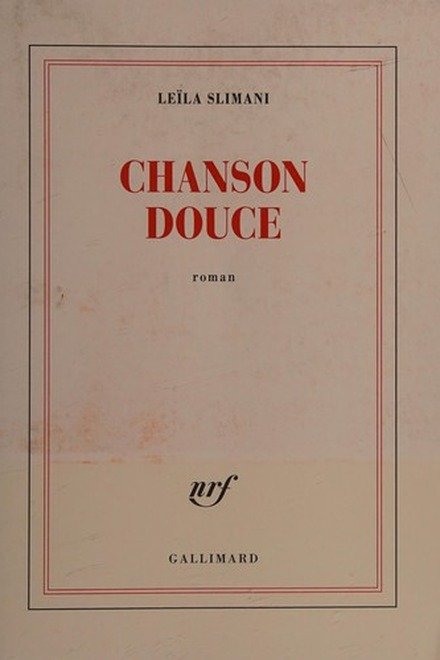
Leïla Slimani opens Chanson douce with a body. Two bodies, in fact: children, murdered by the nanny who was supposed to care for them. The killing is announced on the first page, and the rest of the novel — published in 2016, winner of the Prix Goncourt — circles back to explain how a family and a woman arrived at catastrophe together. The mechanism of suspense is inverted: you know the end before you know the story. What Slimani is actually asking is not whodunit but how did this become possible, and the answer is a precise, unsparing portrait of a particular arrangement of French bourgeois life.
The nanny as mirror
Myriam is a lawyer who wants to return to work. Paul is a music producer. They live in a comfortable Paris apartment; they need someone to run it while they don't. Louise arrives — white, fiftyish, impeccable, grateful — and the novel observes her slide from employee to near-family member to indispensable fixture, a process that suits everyone until it suits no one. Slimani is careful never to sentimentalise Louise or explain her violence away. She remains opaque, a surface onto which the Massés project their needs and anxieties. What the novel dissects is less a psychology than a structure: the way care work is simultaneously essential and invisible, the way employers require intimacy from people they prefer not to see.
The class architecture is exact. Myriam's guilt about leaving her children, her relief at being professionally active, her discomfort at having help — these are rendered without irony but also without endorsement. Paul's breezier, less examined entitlement complements hers. Louise is paid modestly, given no real privacy, expected to be available and undemanding. She is in the home but not of it, necessary but not acknowledged. When things go wrong, Slimani suggests, they go wrong not because Louise is a monster but because she has been made into a function, and functions cannot bear the weight of human desperation.
Two bodies, in fact: children, murdered by the nanny who was supposed to care for them
Why France was unsettled
The Prix Goncourt transformed Chanson douce — published in English as The Perfect Nanny in Sam Taylor's translation — into a cultural event. The novel sold widely and was discussed at the level of roman à thèse: a novel with a proposition. The proposition, which France found uncomfortable, was that the private arrangements of educated, progressive, dual-income families contain a structural cruelty that good intentions do not dissolve.
Slimani, who was born in Rabat and trained in Paris, writes as an insider-outsider to this milieu — aware of its textures, unwilling to flatter them. Her earlier novel Dans le jardin de l'ogre had established her as a writer of psychological acuity and social precision. But Chanson douce went further, implicating the reader's own domestic arrangements in what it describes. A French journalist-class readership — exactly the demographic most likely to have employed a Louise — was handed a mirror and asked to look.
The novel's roots in a real 2012 case in New York, in which a nanny killed two children in her care, give it ballast, but Slimani transposes the crime to Paris and strips it of the sensational coverage that surrounded the original. What remains is the structure, not the spectacle. This is the discipline that makes the book work: the refusal to let the crime be extraordinary, to let bourgeois life off the hook by filing the horror under the mad nanny rather than the arrangement that produced her.

A question the novel does not answer
Slimani does not tell us what to do with the servant problem. She does not argue for a policy or a moral position. The novel ends where it must, with wreckage, and the question — how do we treat the people whose labour we need but would rather not notice? — is left open and uncomfortable. That discomfort is the point. In the argument France's best novels keep making, the bourgeoisie is never simply the villain; it is the reader; it is us. Slimani understands this perfectly, and Chanson douce is most disturbing precisely when its characters are most recognisable, most reasonable, most like the people who awarded it the Goncourt and took it home.
A chronology
- 2012nanny murders case in New York, a partial real-world source
- 2016Chanson douce published; Prix Goncourt awarded
- 2018English translation (The Perfect Nanny, trans. Sam Taylor) published